Air Conditioner or Hidden Heater?
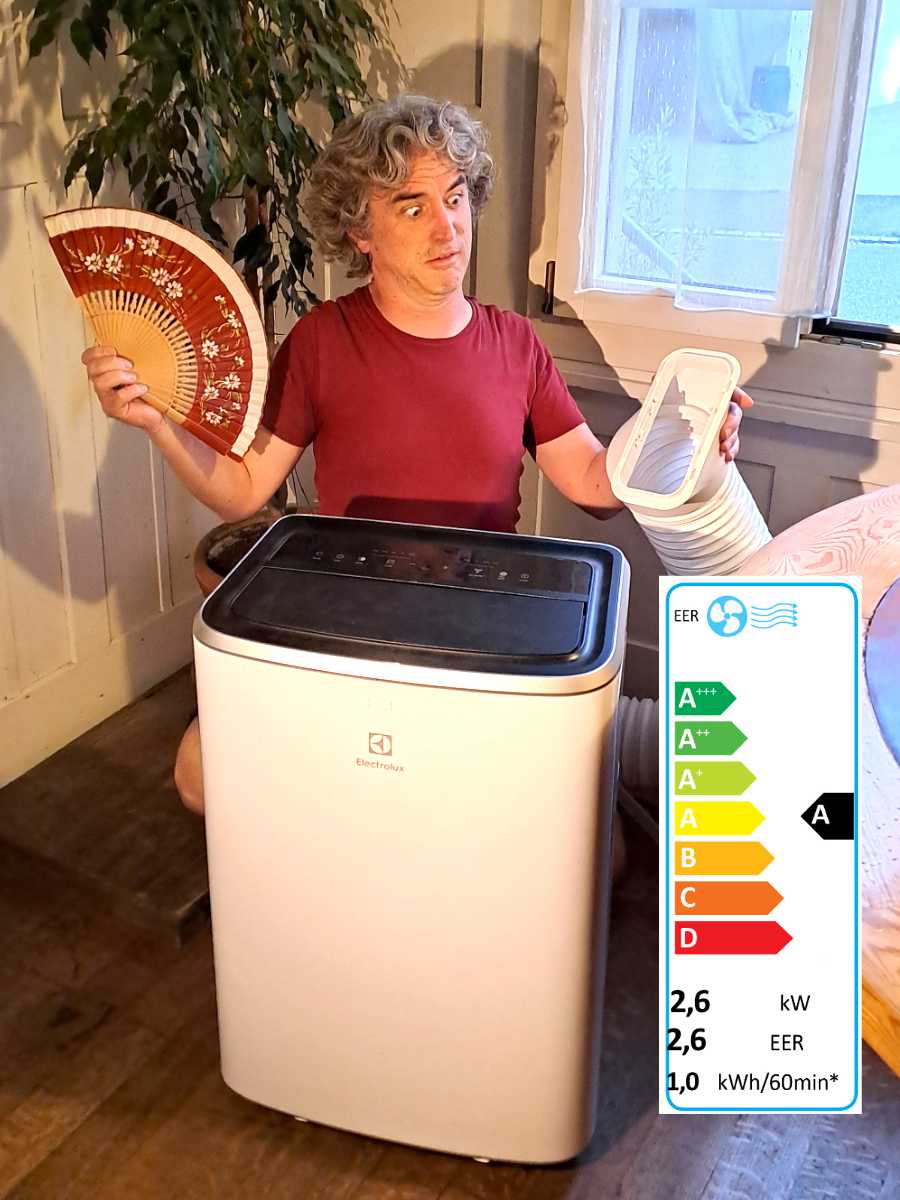
Is this an air conditioner 😎 or a hidden heater 🔥 ?
I saw a mobile air conditioner at a neighbor's house, which she got as a gift. I was amazed to see a device with only an exhaust hose. How can this work?❓
The device, which is set up indoors, sucks in room air, extracts heat from it and blows it back into the room when it has cooled down. And where does the heat go?
Further room air is sucked in, to which the heat is released. This warmed air is blown outwards via the hose. That sounds wonderful: cool air inside and hot air outside – hmm, is that all 🤔?
💡I have to do the math, of course with Calcumber (link to calculate yourself at the end):
The device extracts 2.6 kW of heat output with 1 kW of electrical power. An estimate shows that the device has to blow around 400 m3 of air out of the house per hour – about as much as the entire volume of the house. Is the house airless 😨 after an hour ?
We can breathe a sigh of relief, air flows in, for example through adjoining rooms from outside. Outside, however, as in the summer of 2026 in Switzerland, it can easily be 36°C. The following air heats up the house again, for example with 1.6 kW of power. The net cooling capacity is thus reduced to just 1 kW and the efficiency coefficient ERR drops from a good 2.6 according to the energy label with class A to just 1.0 (which would probably be D minus minus minus).
And when are such devices efficient? Quite simply, when it's cool 😉 outside.
| === Cooling Capacity and Exhaust Heat === | |
| Electrical Power: P_el = 1 kW | 1 kW |
| Cooling Efficiency: EER = 2.6 | 2.6 |
| Cooling Capacity: Qt_cool = EER * P_el | 2.6 kW |
| Exhaust Heat: Qt_ex = Qt_cool + P_el | 3.6 kW |
| === Exhaust Air Volume === | |
| load fluid air | 1 |
| Air pressure: p = 1 bar | 1 bar |
| Room temperature: T_in = 25°C | 25 °C |
| Enthalpy: h_in = h(T_in, p) | 424.439 kJ/kg |
| Exhausttemperature: T_ex = 50°C | 50 °C |
| Ethalpy: h_ex = h(T_ex, p) | 449.609 kJ/kg |
| Mass flow needed: mt = Qt_ex/(h_ex - h_in) to kg/h | 514.895 kg/h |
| Suction volume flow: Vt = mt / rho(T_in, p) | 440.523 m3/h |
| === Following Air from Outside === | |
| Outside temperature: T_out = 36°C | 36 °C |
| Enthalpy: h_out = h(T_out, p) | 435.511 kJ/kg |
| Heating effect: Qt_heat = mt *(h_out - h_in) | 1583.51 W |
| === Real Cooling and Efficieny === | |
| Real Cooling: Qt_k_real = Qt_cool - Qt_heat | 1016.49 W |
| Real EER: EER_real = Qt_k_real / P_el | 1.01649 |
2026-09-08 Samuel
Electricity Consumption of a TV
Do you remember when TVs used flickering cathode‑ray tubes? Screens were much smaller back then — typically around 20‑inches instead of today’s 65‑inch models. Which matters more for energy use: improvements in efficiency, or the increase in screen area?

| Technology | Power per Screen Area |
|---|---|
| Good Old Tube | 500 W/m2 |
| Plasma | 400 W/m2 |
| LED | 120 W/m2 |
| OLED | 180 W/m2 |
Calculate the energy consumption and yearly bill by changing the inputs below. For an old TV, use a 20‑inch CRT and 500 W/m²; for a modern LED TV, use a 65‑inch screen and 120 W/m². Set the aspect ratio to 4:3 for CRTs and 16:9 for modern displays.
And how many hours a day is your TV running?
| Screen Geometry | |
| =============== | |
| Typically, we know the diagonal and the aspect ratio. | |
| Diagonal: d = 20 inch | 20 inch |
| Aspect ratio: ar = 4 / 3 | 1.33333 |
| How to get height, width and area? | |
| Pythagoras: d = sqrt(w^2 + h^2) | |
| Divided by h: d/h = sqrt((w/h)^2 + 1^2) | |
| Using aspect ratio: d/h = sqrt(ar^2+1) | |
| We can solve for h and finally calculate: | |
| Height: h = d / sqrt(1 + ar^2) | 12 inch |
| Width: w = h * ar | 16 inch |
| Area: A = h * w to m2 | 0.123871 m2 |
| Yearly Energy Bill | |
| ================== | |
| Power per Area: ppA = 500 W/m2 | 500 W/m2 |
| Power: P = ppA * A | 61.9354 W |
| Energy: E = 5 h/day * 1 year * P to kWh | 113.109 kWh |
| Cost: c = 14 USDct/kWh * E to $ | 15.8353 $ |
In case you already know the power your TV needs, it is a one-liner:
| TV energy bill: 150 W * 6 h/day * 1 year * 37 EURct/kWh | 121.628 € |
Can You Cook Pasta on Mount Everest?
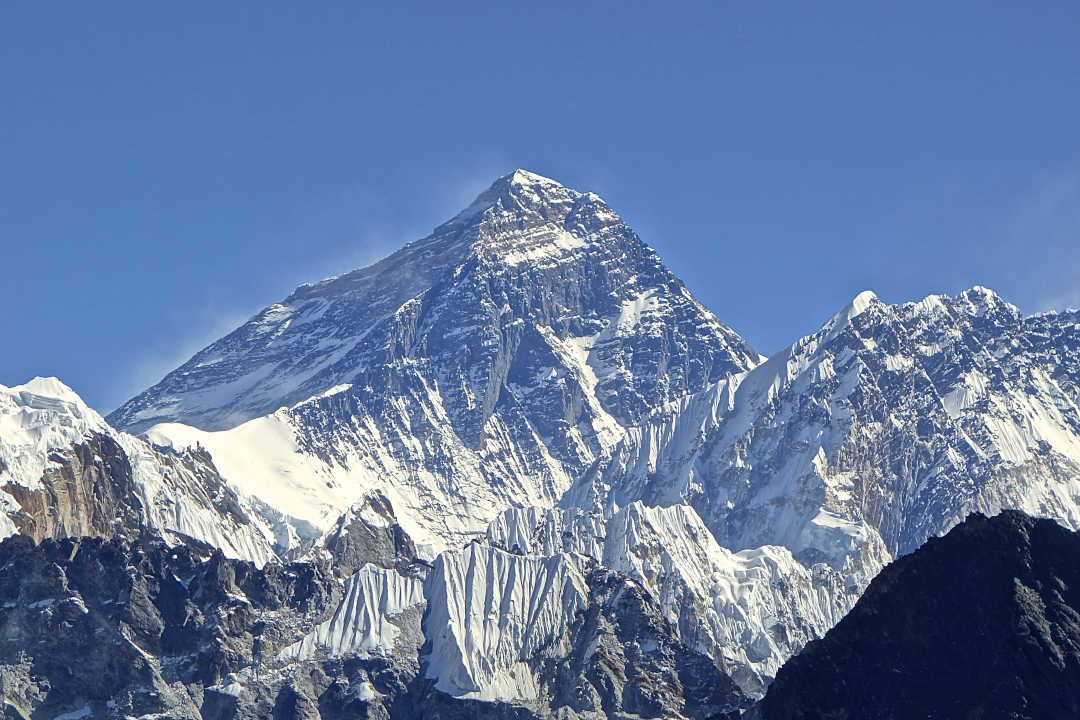

How does the low air pressure affect pasta cooking?
In high altitude, the air pressure is much lower. As a consequence, water will boil earlier than usual!
| Mountain height: | |
| h = 8849 m | 8849 m |
| Air pressure decreases by about 1% every 80 m: | |
| p = 1013 mbar * 99% ^ (h / 80 m) to mbar | 333.279 mbar |
| What is the boiling temperature of water? | |
| load fluid water | 1 |
| T_boil = T(p) | 71.5326 °C |
It is not the bubbles of the boiling water that get your pasta done, it is the temperature. And with only 72°C, you'd have to wait forever.
What about other Mountains, or the elevation of your home?
Edit the calculation above and change the height value
(Matterhorn: 4478 m, Kilimanjaro 5895, Mount Fuji 3776 m, Denali 6190 m, Dead Sea: -430 m).
Fluid Properties Calculator
2026-06-27 by Samuel
Define your fluid and use any pair of pressure, temperature, specific enthalpy, specific entropy, density and vapor quality as parameter 1 and 2. Calcumber then calculates all properties for that state.
See pure fluids and fluid mixtures for a list of available fluids.
| Fluid Selection: | |
| load fluid water | 1 |
| State parameters: | |
| Parameter1: par1 = 20 °C | 20 °C |
| Parameter2: par2 = 1 bar | 1 bar |
| Temperature: T(par1, par2) | 293.15 K |
| Pressure: p(par1, par2) | 1 bar |
| Specific enthalpy: h(par1, par2) | 84.006054 kJ/kg |
| Gibbs energy: g(par1, par2) | -2.9021070 kJ/kg |
| Inernal energy: u(par1, par2) | 83.905874 kJ/kg |
| Specific entropy: s(par1, par2) | 0.29646311 kJ/(kg*K) |
| Density: rho(par1, par2) | 998.20654 kg/m3 |
| Specivic volume: v(par1, par2) | 0.0010017967 m3/kg |
| Vapor quality: x(par1, par2) to % | -100 % |
| Speed of sound: a(par1, par2) | 1482.3440 m/s |
| Viscosity: mu(par1, par2) to mPa*s | 1.0015966 mPa*s |
| Thermal conductivity: k(par1, par2) | 0.59801157 W/(m*K) |
| Specific heat | |
| - at constant pressure: cp(par1, par2) | 4184.0551 J/(kg*K) |
| - at constant volume: cv(par1, par2) | 4156.6862 J/(kg*K) |